
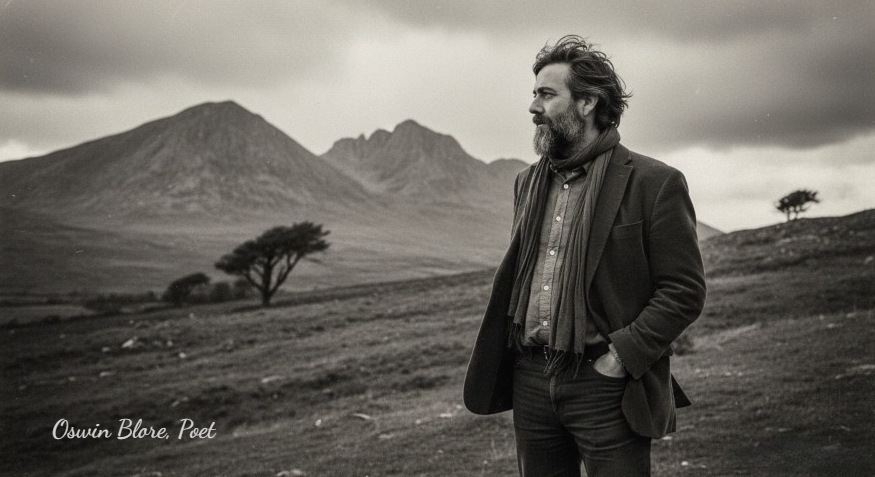
Thursday, 1st January
Four minutes ago it was last year. I have thirty-three diaries in a box under the stairs. My writing and thoughts have matured since the early days. I sat and read entries from my first diary just before the neighbours sang Auld Lang Syne in their garden. I read my early poems too. They’re naïve and, at times, illiterate. My first resolution of this year is to sort through my old notes and scribbles. They’re the weeds that have grown along the path I’ve been walking. The nettles. The cow parsley and white clover. The creeping buttercups and the cleavers. Beautiful in their own right, but they’ll hide the path completely if left unattended.
8:15pm
It has been snowing all day and there must be at least three inches covering the garden. This afternoon, from my bedroom window, I was able to watch the hills beyond the village slowly turning white. The coastline too. Unfortunately, the dog-walkers soon ruined the purity of the snow on the beach. I can see three snowmen lit by the streetlamps in some of my neighbours gardens. The sky is now clear and the stars look magical – like tiny pinpricks of light escaping the dark and ominous sheet of the nothingness we call night.
Harriet brought me some mince pies and asked if I was happy. Just after she left, Reverend Tottle came round to ask me if I’d like to take charge of this year’s living nativity. I reminded him it was only the first day of the year. “There’s another fifty-one weeks until Christmas,” I said. He nodded his head several times.
Merrick is selling all his livestock – cows, sheep, pigs. He’s going to make cheese. Goats cheese. “So we have no animals just an empty stable.” Reverend Tottle said. “Actually we don’t even have an empty stable. Merrick is going to build a milking parlour in its place.” Apparently Merrick’s getting a herd of Toggenburg goats from Switzerland. A lot of them. To make cheese. “A Lot of it,” Reverend Tottle said. And then, he informed me that Gladys Kettle dropped baby Jesus. “His head in in three pieces and looks unrepairable.”
11:15pm
I told Harriet I was happy. I saw ‘Doctor’ Clara in church on Christmas Eve. Her viva voce went well and she graduated soon after. She remains single but has plenty of male and female admirers. She might be moving to France soon, but that’s not confirmed yet. Who’d want to move away from Tarnleigh? I’m not tired, but I really need to sleep.
Friday, 2nd January
When I wake up at night, I talk to Lilly Palgriff. I turn the bedside lamp on and the light in the hall. I brew a cup of tea in the half-light and occasionally the two of us nibble on a biscuit at the kitchen table. We sit and talk for hours. She recently celebrated her 100th birthday. Fortunately I had cake in the fridge.
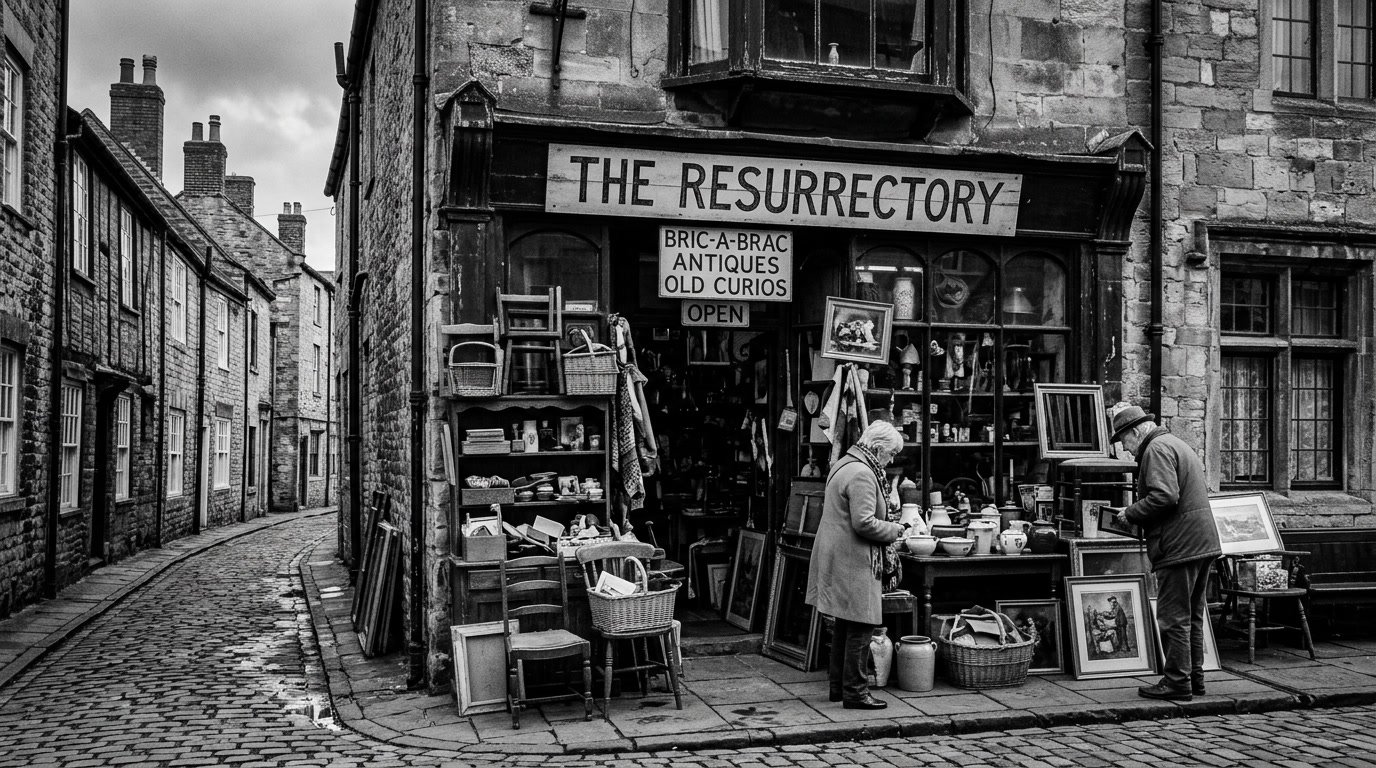
I now have two shops. Divorce forces you to do the things that once belonged to your dreams. “I’m buying my freedom,” Harriet had said. “You can buy that shop you’ve always wanted. It’s for sale again.” Harriet asked me to leave. “I can’t divorce the garden. You’ll have to move out.”
The new shop has a flat and the flat has a tenant. Mr Fisher is an elderly gentleman with a long, grey beard and long, fine silver hair. I didn’t want to evict Mr Fisher, so I moved into a semi-detached house along Groverake Lane. It’s nice. Harriet chose it for me. “It’s not that I don’t love you, it’s just that I don’t know what love is anymore. I’m not sure I ever did,” she said, as she handed me the keys. “I plan to find out what it is, though. Christians pray about it. Hippies sing about it. If it’s out there somewhere, I’ll find it.”
Harriet’s my third wife. The Resurrectory is my second shop. This is my fifty-second year in Tarnleigh. Mr Fisher is my first tenant. “We’re just passing through,” Lilly said as she watched me looking through my old diaries and notes. “We’re history’s rag-and-bone.” I was given Lilly Palgriff’s Lustreware Urn, which she still occupies, by her daughter Cheryl. She couldn’t cope with it anymore and asked me to “do something with mum.”
Lilly had always been good to me. I keep her under the sink, next to the recycling bin, except at night. She waits on the table for my insomnia to drag me downstairs. This morning I woke up with a pen in my hand. The wooden pen Lilly Palgriff gave me years ago for having looked after her poodle for a week.
Friday, 9th January
Edwina Sponge turned up with a slice of key lime pie and a dead canary. It took us three hours to identify who it belonged to. Mr Schneider, who lives in the old house on the cliffs, the house that most people imagine is condemned, has a caravan full of canaries. He breeds them for the miners who continue to work the shafts at Blackroot Mine. I think Edwina is going to visit him today. She’s going to return ‘Flighty-No-More,’ the stupid name she gave to the canaries’ carcass, to Mr Schneider so that he can give it a “proper burial.”
I’ve run out of toilet paper and jam. I also fancy one of those nice Quiche Lorraine’s that the corner shop has started selling. They’re home baked and taste wonderful. I also want to take some photos of frost. The resident garden robin has been watching me as the feeder is empty so I’ll need to get some seed too.
I need to write a poem.
I call myself a poet. In fact, I’m a poorly educated son of a farm-worker. I was born at home in 1970 in a tied cottage 40 miles south of London, in a place called Headley Green. Mum was a housewife. In 1974 we moved north to Tarnleigh. Dad became one of the town’s seven milkmen and we got a council house. Life was good. I moved out when I married Clara. I was just 18.
“I wouldn’t have believed it,” said Edwina, “I thought you’d been to private school with all your books, and you being so polite and good-mannered.” The other day she asked me why I go to church. “Because I believe that life has meaning,” I said. She shrugged her shoulders. “I don’t even know what that means.”
I don’t like being on my own.
This morning I carried out my first review of the new shop’s stock. There are several shelves of well-read books, a lot of chipped porcelain, several old clocks, a lot of toys, several attractive wands, mysterious curiosities, and a host of oddities. There’s a lot of commonplace items too. In fact, the shelves sag beneath a legacy of ordinary lives. Rosalie Green, the previous owner, told me that much of the stuff has been bequeathed to the shop by those who now lay hidden in the cemetery.
Mr Fisher gave me a Venetian Murano glass pen. I was busy waiting for customers. The old man had been out. I watched him park his Morris Minor Traveller in front of the shop. I had just started eating my packed lunch – cheese and pickle sandwich, fruit scone with butter and a flask of tea.
He came into the shop and looked around. “I’ve been to Hexham,” he said. “That scone looks nice.” I offered him half. He nodded his head as he took the scone from my hand. “It’s all about stuff isn’t it,” he said, just before pushing the entire half-scone into his mouth.
“I’ve got something for you,” he said. He left the shop and climbed the stairs to his flat. I could hear him moving about above my head. He was smiling when he came back down. He handed me the glass pen. “Here, take this. A priest friend of mine gave it to me when I visited the Vatican. He said it was made in 1859. Use it. Talk to it. A glass pen is the best friend you’ll ever have.” He winked and chuckled. As he was leaving I called out. “What’s your name,” I said, “I can’t keep calling you Mr Fisher.” He waved his hand in the air. “Godfrey,” he laughed. “Godfrey Fisher. But my friends call me God.”
This evening I came across this quote.
When I was telling Edwina about my tenant, she laughed. “God!” she shouted. I had my box of diaries on the table. She told me about her dad who kept a diary all his life. “I have them in the loft,” she said. “I hope the rats haven’t chewed them.” She gave me some fresh scones and a small pot of homemade blackcurrant jam. We played scrabble. I can’t remember who won.
Friday, 16th January
How strange. I fell asleep in my armchair and dreamt I was on a carousel in Paris. The Eifel Tower looked small. Godfrey was playing guitar in a café. All the buildings around began to crumble, but the dream remained peaceful. Something new was coming, something exciting. In the dream I knew what it was but not now. Words were a thing of the past. I sensed that they weren’t needed. People smiled at each other and that was enough. Just before I woke up, a herd of cows appeared and one of them began licking my face. As I woke I remember thinking that at last I was in the right place.
Monday, 19th January
This morning I woke to the sound of a ship’s horn cutting its way through the heavy sea-fog. Tarnleigh’s harbour has been quiet. I’ve only seen two fishing boats leave so far this week. Tarnleigh has few fishing boats left. It has plenty of ex-fishermen willing to tell their stories, if you buy them a pint as they sit to while away the time at The Salt Horse Inn.
Christmas has now moved beyond the horizon and we’ll not see it again for another year. Before then I have to find a newborn child – clay, plastic or even flesh and blood. A stable, and a Mary and Joseph. The three wise men will once again be the Smith brothers and the shepherds will be the children of Blackroot School. My own belief in the story of Christ’s birth has been fading, like ink on a page left in the sun. It was once for me, a meta story, the very foundation of my approach to life.
Yesterday evening was particularly dark and cold.
Tuesday, 3rd February
I’m having a lot of powerful dreams at the moment. Last night I dreamt I was trying to pull someone out of a deep, muddy hole. I feel I live increasingly on the surface of things. I barely touch reality. I’m far too immersed in the human narrative, which is becoming increasingly materialistic. I’m now committed to embracing the natural as I used to. The power of words is that they can show us the way back. ‘A diary is a path back into ourselves.’ I read that somewhere. Something is moving in that deep, muddy hole, and I think it belongs to me.
11.15pm
I don’t pretend to understand much of what I’ve read in The Journal of Speculative Chronophysics. But it does help me to get to sleep. I’ve tried counting sheep, playing mental scrabble and knitting, but nothing gets me to sleep better than a bit of theory.
Yesterday I found Mrs Kettle standing in the cemetery in front of an empty, freshly dug grave as if she was waiting for someone to push her in. She spends a lot of time wandering alone amongst the graves since her son died. About two inches of snow lay on the winter grass and on the empty branches of the trees. I stood a while watching her. Blue sky began to appear as the clouds swirled apart. I could see her breath leaving her slightly opened mouth. I found it all so beautiful. I wrote a poem.
I’ve been looking for a novel I wrote twenty-seven years ago. I found the Olivetti typewriter I used. How much of our life is kept in boxes? I’ve always felt the need to write. Speech falls like rain. It appears and then flows away to join the great ocean of indivisibility. Written words linger. They gather together into small clusters of meaning – like friends around a campfire.
Wednesday, 4th February
Harriet got me the curtains that hang in my bedroom. I had kept them in a box under the stairs since I moved into the house, and they would have stayed there, but the day before yesterday, when I went round to clean the gold-fish pond, my only post-divorce responsibility, she asked me if I’d used the curtains. “I bought them for you,” she said as I was removing my wellies. “Do you remember our cheese-on-toast soirées?” she said. I think we were happy.
8:30am
There’s mist on the hills. The clock’s tick tends to be more clunky when it’s damp outside. It’s tock seems unaffected. It’s a very old timepiece and has arthritis in its hands. It’s pendulum has problems too. It has to have three drops of steroids administered to its swinging mechanism every month. I hide the steroids in WD-40 so the clock’s none the wiser.
February isn’t my favourite month.
Yesterday I went to the dentist. He was taller than I expected. He had an Irish accent and was playing Beethoven’s Pastoral Symphony on an old record-player as he scraped bits of calcified plaque from between my teeth. He drew blood. I could taste it. I could hear trains rumbling over the viaduct that passes just above the dentist’s extensive premises.
“I’m Seánóg,” the dentist said, just moments before he invited me to sit in his leather lounger and began tutting at my teeth. “Your teeth are older than you, by about ten years,” he said. He looked up at his assistant. A woman with naturally grey hair and a slightly crooked nose. “We’ll need to keep a close eye on his premolars.”
The woman wrote something down on a scrap of paper. “The computer’s still not working,” she moaned. She placed a piece of pink gum in her mouth and then smiled at me. It was a nice smile. Her teeth looked quite young. “It’s alright,” she said, winking at me. “I never forget anything. I’ve got an elephant’s brain. Isn’t that right Dr Delaney.”
Dr Delaney rolled his eyes. “Your skull’s not big enough for an elephant’s brain. The pachyderms’ encephalon is three to six times larger than a human’s and a lot heavier.”
I was unable to comment as three of the dentist’s fingers and some sort of implement, were in my mouth. I was beginning to salivate and began to worry about drowning. Can you drown on your own saliva? I didn’t want to swallow for fear of biting one of Dr Delaney’s fingers off.
The oral ordeal ended at about the same time the record-player finished playing the last movement of Beethoven’s symphony. I’ve always loved Beethoven. I love classical music. I was pleased to get Dr Delaney’s fingers out of my mouth.
At one point I remember asking what had happened to my usual dentist, Mrs Ditheridge. “She has eleven whippets,” Dr Delaney replied. I’m not sure how that answered my question but the dentist said nothing more on the matter and the assistant just shook her head and mumbled something like, “I can only afford three.”
On the way home I stopped on Waldridge Fell and watched several grouse roaming amongst the heather as if they were looking for something. I kept the car’s engine running. A passing hiker stared at me angrily and then tripped on a stick. This startled the grouse making them fly away in three different directions. The hiker began swearing at the stick. He picked it up and threw it. Due to its curved shape, it returned to him like a boomerang and hit him on the head. I wasn’t really paying attention to the hiker’s misadventure as I was busy trying to remember cheese-on-toast soirées with Harriet.
I had pizza and chips for tea. With some marrowfat peas.
I struggled to sleep again. I dreamt the dentist was a famous pianist. He was performing at the London Palladium in front of the King and an audience of attractive women of varying ages. A grouse suddenly appeared out of the piano and woke me up.
The typewriter needs servicing. I think the novel I wrote twenty seven years ago is in the tin box in the shed. It wasn’t any good. But I’d like to read it again.
